How to Overcome Impostor Syndrome at Work


Table of Contents
Impostor syndrome is simply a memory problem that makes your brain quietly edit your own achievements out of the story. Neil Armstrong felt like an impostor too, even though he stands among history’s most accomplished figures, so there’s no real reason you’re supposed to feel any different.
However, you can overcome impostor syndrome in smarter ways today and shrug it off your personality to save yourself from unnecessary self-doubt and missed opportunities.
What is Impostor Syndrome at Work?
Impostor syndrome at work is a psychological problem where successful, high-performing people are unable to internalize their own accomplishments. It has nothing to do with a lack of talent.
Asana’s workplace research found that 62% of workers worldwide experience impostor syndrome at some point in their careers. The pattern holds inside specific industries too. For example, Marketing Week’s recent data shows that 85% of marketers report having experienced impostor syndrome.
Is Impostor Syndrome a Serious Issue at Work?
Yes. It can genuinely hurt your career if you leave it unaddressed. When you’re convinced you’re not truly up to the job, you stop asserting yourself. You stop taking the risks that a role needs from you. Your focus narrows to not making a mistake, instead of doing something meaningful.
The Five Types of Impostor Syndrome (& Which One Are You?)
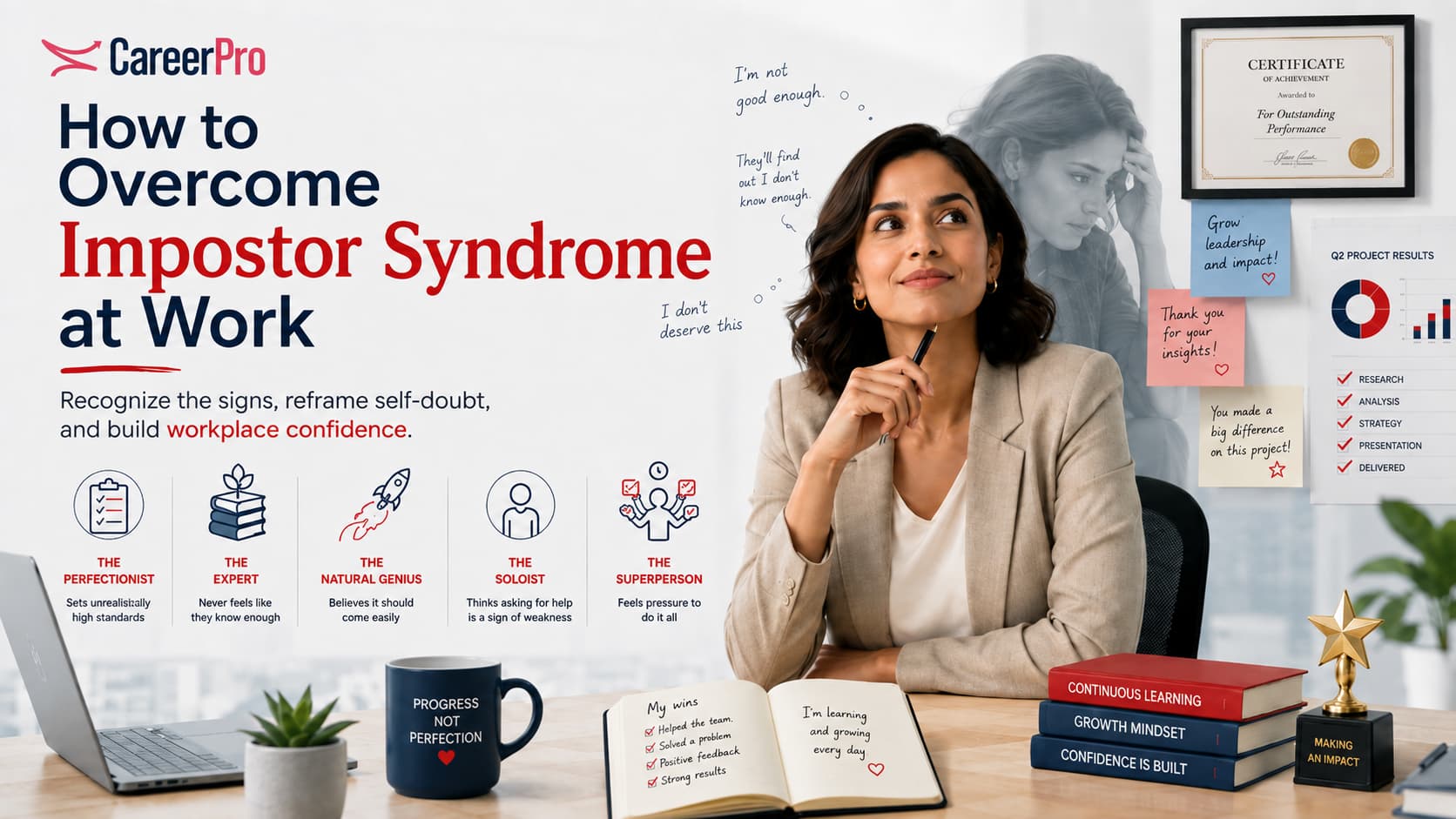
The perfectionist, the expert, the natural genius, the soloist, and the superperson are basically five main types of impostor syndrome.
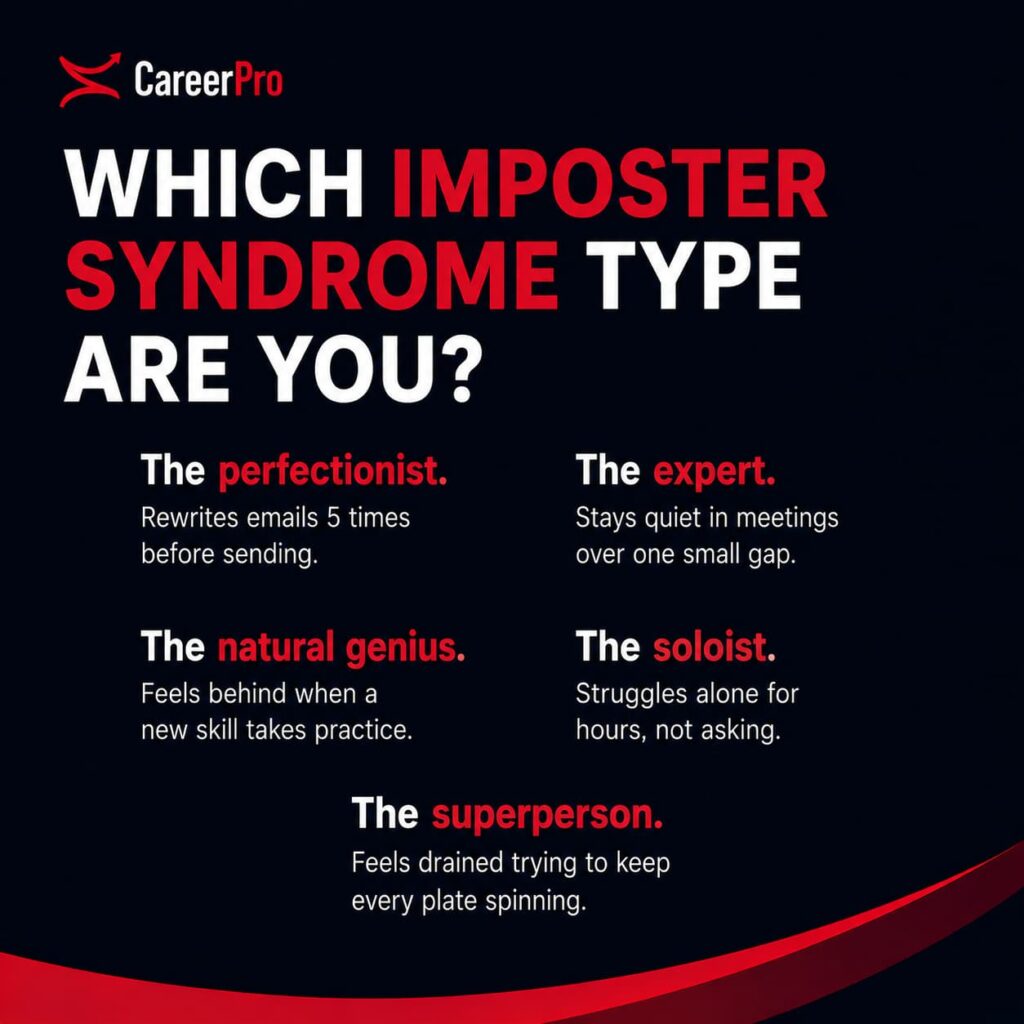
All these types show up differently. Here’s how:
- The Perfectionist
The Perfectionist judges every task by how it was done, not just whether it got finished. They set extreme goals for themselves, and the moment their work isn’t flawless, they feel like a failure.
For example, if you rewrite the same email five times and it still doesn’t feel flawless to you, you are a Perfectionist.
- The Expert
The Expert measures their worth by what and how much they know. The instant they don’t have every fact or step memorized, even in areas where nobody is expected to know everything, they feel like a fraud.
For example, if you stay quiet in meetings just because of one single unknown detail, and you are afraid to speak up because of that, you are an Expert.
- The Natural Genius
Speed and ease are how the Natural Genius measures their own competence. The moment a skill doesn’t click on the first try, they declare it as proof that they don’t belong.
For example, if you feel like quitting on a new tool when it doesn’t click on the first try at work, you are a Natural Genius.
- The Soloist
The Soloist believes they have to do everything entirely on their own, seeing any request for help as a sign of weakness. So they quietly carry more than they should.
For example, if you struggle through a task alone in silence when a quick question could’ve solved it at work, you are a Soloist.
- The Superperson
The Superperson tries to excel at every role at once, employee, parent, friend, and everything in between. Falling short in even one area brings real shame to them.
For example, if you feel like you’re failing in one area of your life when everything else is going well at the same time, you are a Superperson.
Advice from 3 Thoughtleaders on How to Get Over Impostor Syndrome at Work (With Practical Examples)
These experts explain how to defeat impostor syndrome at work, no matter which of the five types you saw yourself in above. Their advice comes from decades of real research and real client work.
- Dr. Valerie Young
Dr. Valerie Young is a Global Thought Leader on Impostor Syndrome, Keynote Speaker, Co-Founder of the Impostor Syndrome Institute, and an Award-Winning Author.
What Dr. Valerie Young Says About Beating Impostor Syndrome at Work
Dr. Young says shame is what keeps most people from admitting they are dealing with impostor syndrome. The moment you realize there’s a feeling inside you that is forcing you to think that you’re a fraud, for example, and you name that feeling, you can deal with impostor syndrome in a better way.
Dr. Young also points out that a sense of belonging builds confidence when you’re dealing with impostor syndrome. If you’re the only person in the room who looks, sounds, or is aged differently than everyone else, it’s completely natural to sometimes feel a bit out of place.
So, instead of seeing your self-doubt as proof that you’re incapable, recognize it for what it is: a normal reaction to being on the receiving end of social stereotypes about competence and intelligence.
- Tiffany Tate
Tiffany Tate is the founder of Career Maven, where she works with clients to demystify the job search process. In her collaboration with Wake Forest School of Professional Studies, she advised students on how to deal with the impostor syndrome they’d likely face once they entered the workforce.
What Tiffany Tate Said About Beating Impostor Syndrome at Work
Tate explains that the first step is simply noticing when impostor syndrome shows up: a persistent fear of being found out, crediting your success to luck instead of skill, or downplaying what you’ve achieved.
Once you can name it, you can start disrupting it. So, when a thought like I just got lucky shows up, replace it with the reminder that your skills and efforts got you there.
To put this into practice, start journaling your feelings. Every time you notice impostor syndrome creeping in, write down what triggered it and how you reacted. Reread it often to spot patterns, because once you know your specific triggers, you can prepare for them instead of being caught off guard.
- Michael Page
Michael Page is a global professional recruitment consultancy that helps corporate clients source, recruit, and manage specialized talent. It also offers professional consultation, market guidance, and strategic hiring advice to corporate clients.
What Michael Page Says About Beating Impostor Syndrome at Work
Michael Page’s advice is built around a simple idea: comparing yourself to your colleagues is a game you can’t win. Everyone’s career journey moves at a different pace, so measuring yourself against someone else’s timeline will only create unnecessary doubt and will force you to think that you’re an impostor.
So, instead of saying I’m not good enough, say I am qualified and capable of achieving my goals.
Write it on a sticky note and stick it somewhere you’ll see daily, your monitor, your mirror, your desk. Over time, this consistent practice does more to quiet the impostor feeling than any pep talk ever will.
3 Examples of Real People with Impostor Syndrome (& How They Fixed it)
Impostor syndrome doesn’t discriminate by seniority or success. Here’s how four real professionals, from early-career to the C-suite faced it head-on and came out the other side.
A scientist described how he couldn’t shake the feeling of faking it, even after two years in conservation work and four different roles, and even after receiving nothing but positive feedback in his last position. His monitoring report was so well received that it doubled the budget for his own position, yet he still felt like a fraud.
How It Affected Them
When this scientist was offered an interview for a highly competitive research role in Antarctica, he questioned whether he truly deserved that shot instead of feeling proud of the opportunity due to his impostor syndrome.
What He Did to Overcome impostor Syndrome
It was a mindset shift that helped him, rather than any single tactic. He was told by people around him that doubting one’s own suitability for a role he had already excelled in wasn’t humility but a disease.
Were They Successful After That
Yes, he went into the Antarctica interview even though his self-doubt was still there, but he went anyway. He leaned on the mindset shift instead of waiting for the doubt to disappear entirely, which is exactly how situations like these are supposed to be handled initially.
This product designer was moving from his mid-level position into his first senior role, which made him nervous before all the formalities even began. He was worried about how he would adapt to new processes and also had self-doubts regarding his current approach at work. The fun fact was that he didn’t realize he’d earned that senior position on merit because of his exact current status quo.
How It Affected Them
He wasn’t worried about not being able to deliver on performance, but about the pressure of a title jump. Realizing he’d be dealing with more responsibility from now on shook his confidence going in
What He Did to Overcome impostor Syndrome
He booked short one-on-one sessions early on with his new team to understand how they already worked. He held back from pushing his own opinions until he’d actually learned the internal context. And he kept a running log of his work to stay organized and visible.
Were They Successful After That
Yes. A year later, things had gone smoothly for him. He gave credit to curiosity and a willingness to keep learning when going through impostor syndrome, not to suddenly feeling confident overnight.
An experienced professional reached a CXO position at a well-known publicly traded company. But most days, he still expected it could all end at any moment. The feeling of being behind in conversations or not knowing the internal politics never fully went away, even with that senior role.
How It Affected Them
Even though he was in a strong position by the time he reached the C-suite role, he still brought back the past instances where he was fired three separate times over the course of his career, and kept amplifying that feeling.
What He Did to Overcome impostor Syndrome
One good thing he did was he asked for help openly instead of hiding his feelings. He stayed transparent about what he didn’t know, and as a result got his seniors and same-level colleagues to mentor him, which eventually helped him manage the issue.
Were They Successful After That
Yes. When he realized that a lot of people in any organization aren’t even great at their jobs and they still keep them anyway, he found it easier to accept the senior position, even though his self-doubts didn’t go away totally. He took it anyway, with a relaxed mindset.
Conclusion
As you’ve read above, even C-suite executives and people like Neil Armstrong have dealt with impostor syndrome at work. Statistically, the people most likely to feel like frauds at work are the ones least likely to actually be one. This means the feeling itself was never reliable evidence of anything.
If self-doubt is what’s holding you back from applying for the role you deserve, our team at Career Pro can help with coaching, resume support, and interview prep, so you can go after that role with confidence.
Frequently Asked Questions
Does impostor syndrome ever completely go away?
No. It doesn’t disappear fully instantly, but it fades and gets far easier to manage with practice.
Is impostor syndrome a real mental illness?
No. It isn’t an official diagnosis, but the stress and self-doubt it causes are very real.
Is it normal to feel like an impostor after a promotion?
Yes. New responsibility often triggers self-doubt, even in people who are clearly capable and prepared.
Can impostor syndrome be a good thing?
Sometimes, yes. A little self-doubt keeps you humble, careful, and motivated to keep improving your work.
Do only beginners or junior employees experience impostor syndrome?
No. Senior leaders and high achievers often feel it more as pressure grows. We discussed several examples in this blog.
Is impostor syndrome the same thing as low self-esteem?
No. You can feel deeply confident in life and still doubt your competence at work specifically.
Should I see a therapist if impostor syndrome feels overwhelming?
Yes. Talking to a professional helps when self-doubt affects your sleep, mood, or daily performance.