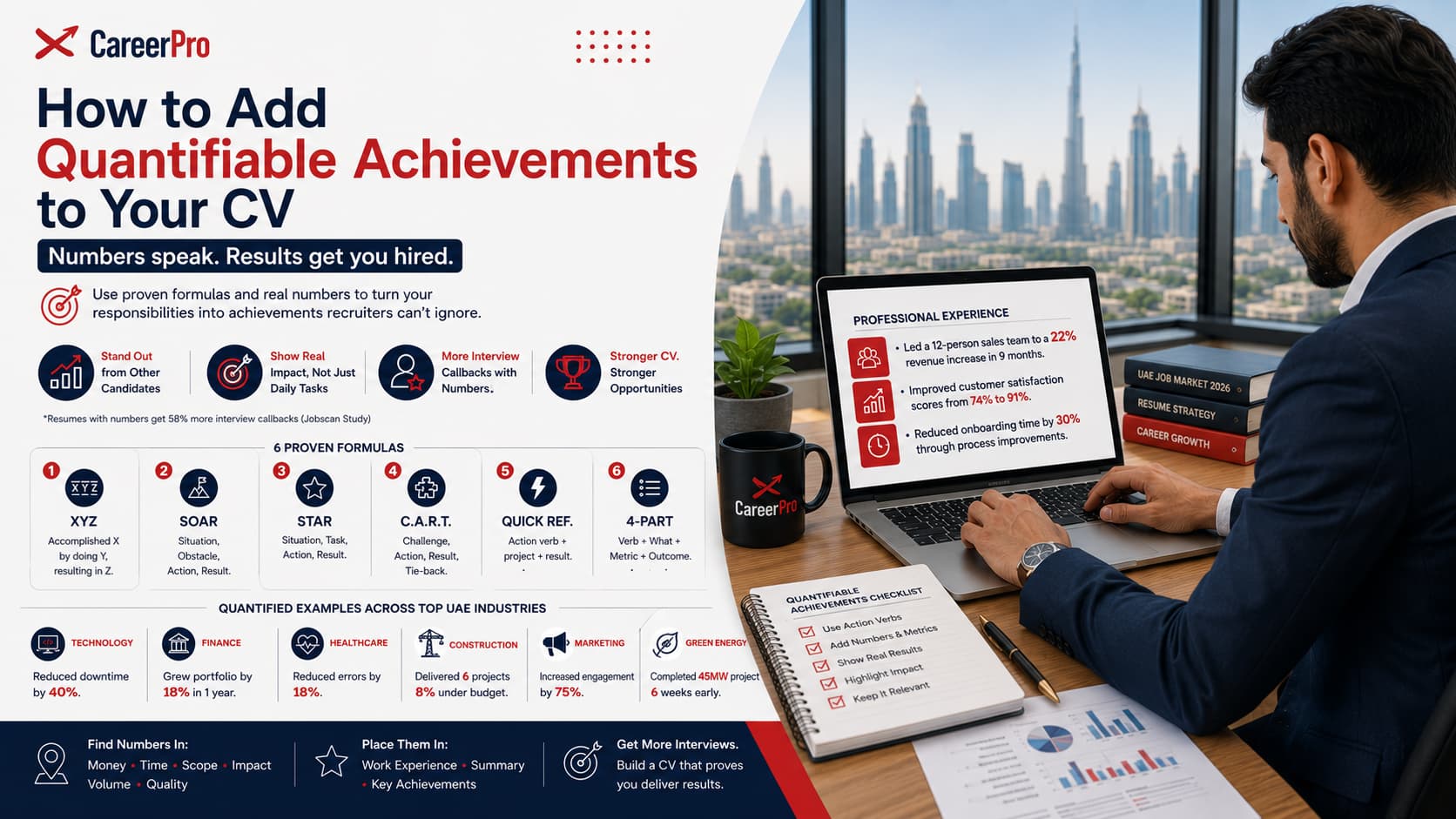
How to Add Quantifiable Achievements to Your CV


Table of Contents
Two candidates apply for the same role. Both have the same job title and same years of experience, but only one of them gets the callback. Moreover, both of them have done the same level of work. The only difference is one of them hasn’t written it down in a way that proves it.
The CV of the rejected person contained sentences like Responsible for managing the sales team and improving customer satisfaction. He got rejected because all the recruiter saw were huge walls of text on his resume.
While the person who got shortlisted had written on his resume Led a 12-person sales team to a 22% revenue increase in 9 months while lifting customer satisfaction scores from 74% to 91%. The recruiter spent 6 to 8 seconds on his CV and shortlisted him.
Had the rejected candidate used the methods below to display his achievements, he could have been shortlisted too. He didn’t, but you can. So use them for the next role you apply to and get shortlisted this time.
How to Display Measurable Results on Resume with Quantifiable Achievements
Before you use the following six formulas to show quantifiable achievements on your CV, collect your numbers. You need to collect substance first, then use it in formulas to craft quantifiable bullets that can be put in your resume.
-
The XYZ Formula
Use the XYZ formula when you already know your number and just need a one-line rewrite.
Formula: Accomplished X by doing Y, resulting in Z.
Before XYZ Formula: I help reduce onboarding time.
After XYZ Formula: Cut onboarding time by 30% by redesigning the new-hire training schedule.
-
The SOAR Method
Use the SOAR method when you want to show problem-solving under pressure. This formula suits leadership roles or career highlights mostly.
Formula: Situation, Obstacle, Action, Result.
Before SOAR Formula: Managed the transition to a new inventory system.
After SOAR Formula: Rolled out a new inventory system mid-peak-season despite a 2-week vendor delay.
-
The STAR Method
Use the STAR method when you want to show directness and problem-solving nature. This formula is one of the widely used frameworks, the one usually taught for interview answers.
Formula: Situation, Task, Action, Result.
Before STAR Formula: Handled customer support tickets and helped improve response times.
After STAR Formula: When the support queue was overwhelmed (Situation) and response times needed to come down (Task), I built a new triage system and retrained the team (Action). As a resume bullet: Cut average support response time by 20% with a new ticket-triage system and a retrained 6-person team.
-
The C.A.R.T. Method
Use the C.A.R.T method when you’re highlighting your top 2 to 3 headline achievements. These are the ones you want to talk about in an interview.
Formula: Challenge, Action, Result, Tie-back.
Before C.A.R.T Formula: Responsible for managing organizational restructuring initiatives.
After C.A.R.T Formula: Halted a 60% revenue decline by restructuring operations and rebuilding team processes. That delivered a 40% productivity gain within 8 months.
-
The Quick-Reference Formula
Use the quick-reference formula when you need one clean sentence and nothing more.
Formula: Action verb + project + result.
Before Quick Reference Formula: Worked on updating the company’s pay structure.
After Quick Reference Formula: Migrated 90% of staff onto a new pay-banding structure. That lifted pay-transparency satisfaction from 13% to 78%.
-
The 4-Part Breakdown Formula
Use it when C.A.R.T. and quick-reference formulas don’t create bullets that capture enough detail for your case.
Formula: Verb + What + Metric + Outcome.
Before 4 Part Breakdown Formula: Managed supplier invoicing and improved efficiency for the finance team.
After 4 Part Breakdown Formula: Streamlined the supplier invoicing process, cutting processing time by 3 days and freeing up the finance team for higher-value work.
Before and After Resume Bullet Examples for 6 Top UAE Industries
The UAE job market in 2026 is running hottest in technology, finance, healthcare, construction, sales and marketing, and green energy. Specialists who can prove their results with numbers are getting bigger raises than generalists with vague CVs. Here’s what a quantified bullet looks like in each of these six industries.
-
Technology
Don’t say: Worked on backend systems and fixed bugs.
Instead say: Optimized backend infrastructure, reducing system downtime by 40% and cutting page load time by 1.2 seconds.
-
Finance & Banking
Don’t say: Handled client accounts and reporting.
Instead say: Managed a AED 25M client portfolio, growing assets under management by 18% in one year through proactive relationship reviews.
-
Healthcare
Don’t say: Completed medication therapy management for patients weekly.
Instead say: Delivered medication therapy reviews for 40+ patients weekly, reducing prescription errors by 18% through a redesigned workflow.
-
Construction & Real Estate
Don’t say: Oversaw project delivery and site teams.
Instead say: Delivered 6 infrastructure projects on schedule and 8% under budget, supervising a site team of 25.
-
Sales & Marketing
Don’t say: Managed social media accounts and marketing campaigns.
Instead say: Grew organic engagement 75% and added 20,000 followers in 6 months through a targeted content strategy.
-
Green Energy
Don’t say: Responsible for managing renewable energy project rollouts.
Instead say: Led a 45MW solar farm installation across 2 sites, delivering the project 6 weeks ahead of schedule and 15% under budget through vendor renegotiation.
Where to Place Your Quantified Achievements on Resume
All the rules you’ve learned are great, but that doesn’t mean you can put them anywhere they don’t suit. Make sure you place them where they work in favor of your CV, not against it. For example, place them in:
- Work Experience Section: For every job you list, write 2 to 3 bullet points that each contain a number. Each bullet point should name the task you worked on, and the number that shows measurable results on your resume.
- Personal Profile or Summary Section: Place your 1 to 2 strongest, highest-level metrics in the first few lines, so a recruiter sees your biggest win immediately.
Where to Find a Number When You Think You Don’t Have One
Every formula above needs a number to plug in. If you can’t think of one, try finding it in money, time, scope, impact, volume, or quality of the work you did. Still, if you don’t get the exact figure, a defensible estimate works fine, something like 15+ team members or over 500 clients, as long as you could explain it in an interview if asked.
- Money: Look at what money you brought in, or what money you stopped from being wasted.
Example: Reduced supplier costs by AED 180,000 annually through contract renegotiation.
- Time: Look at which task got faster once you were the one doing it.
Example: Cut report turnaround from 5 days to 1.
- Scope: Look at how many people, accounts, or markets you were responsible for.
Example: Managed a portfolio of 40+ client accounts across 3 markets.
- Impact: Look at what percentage got better because you were involved.
Example: Improved customer satisfaction scores from 74% to 91%.
- Volume: Look at how many cases, projects, or units passed through your hands.
Example: Processed 200+ claims per month with zero compliance flags.
- Quality: Look at what error rate or accuracy level improved while you owned the process.
Example: Reduced data entry errors by 35% after introducing a double-check workflow.
Conclusion
This blog taught you what to look for and where to look at when collecting quantifiable achievements for your CV. So the next time you write your CV, just go back through the formulas and 6 metric categories above, and make sure you never write a generic resume again.
And if you’d rather have someone build it with you instead, Career Pro’s resume writing specialists can write your CV from scratch or review the one you already have. Get in touch to get started.
Frequently Asked Questions
Does every resume bullet point need a number?
No. Some roles never produce clean metrics. In that case, describe the scope of what you handled, like team size or budget, or name a form of recognition, like an award you received.
Is it okay to estimate a number if I don’t remember the exact figure?
Yes. You can use an estimate, as long as you could explain how you arrived at it if the recruiter asked.
Should I make up a number if I genuinely have none?
No, never invent a number you can’t explain, because interviewers ask follow-up questions every time they see a number.
Is it bad to use the same formula for every bullet point?
Yes, repeating the same formula in every bullet starts to sound robotic. Mix up the formulas as you go, so that each line reads like it came from a person, not a CV template.
Can recruiters actually tell when a number looks exaggerated or fake?
Yes. Recruiters see hundreds of resumes a week, so an inflated number stands out fast and costs you credibility. Keep every figure honest and easy to defend if they ask about it in an interview.
Do entry-level candidates or new graduates need quantified achievements too?
Yes. If you don’t have paid work experience yet, pull numbers from class projects or volunteer work instead, how many people you coordinated, how much you raised, and how many hours you put in.
Will adding numbers to my CV really increase my interview callbacks?
Yes. According to a Jobscan study, resumes with numbers get 58% more interview callbacks.