How to Set Professional Goals (with examples)


Table of Contents
Just like you can’t reach a destination without navigation, you can’t grow a career without setting goals. Whether you want to earn a promotion, develop new skills, or increase your income, setting goals keeps your career journey smooth without U-turns and frequent stops.
According to research cited by Mooncamp, employees who set professional goals are 14.2 times more likely to feel inspired at work than those who don’t. This guide will walk you through exactly how to set professional goals with examples that turn your scattered effort into real career progress.
Difference Between Personal and Professional Goals
Before diving into how to set professional goals, it’s essential to understand how they differ from personal goals, as mixing them up often leads to burnout in both personal and professional life.
| Personal Goals | Professional Goals |
| Personal goals focus on lifestyle, health, relationships, and well-being — like saving money or spending more time with family. | Professional goals focus on career growth, skills, and performance — like earning a certification or a promotion. |
| It includes short- or long-term objectives, such as saving money, spending more time with family | It includes earning a certification, gaining new skills, achieving a promotion, or taking on greater responsibilities. |
| It helps you create a fulfilling life outside work and maintain a healthy work-life balance | Personal goals build a fulfilling life outside work; professional goals advance your career. |
The 6 steps to set professional goals are:
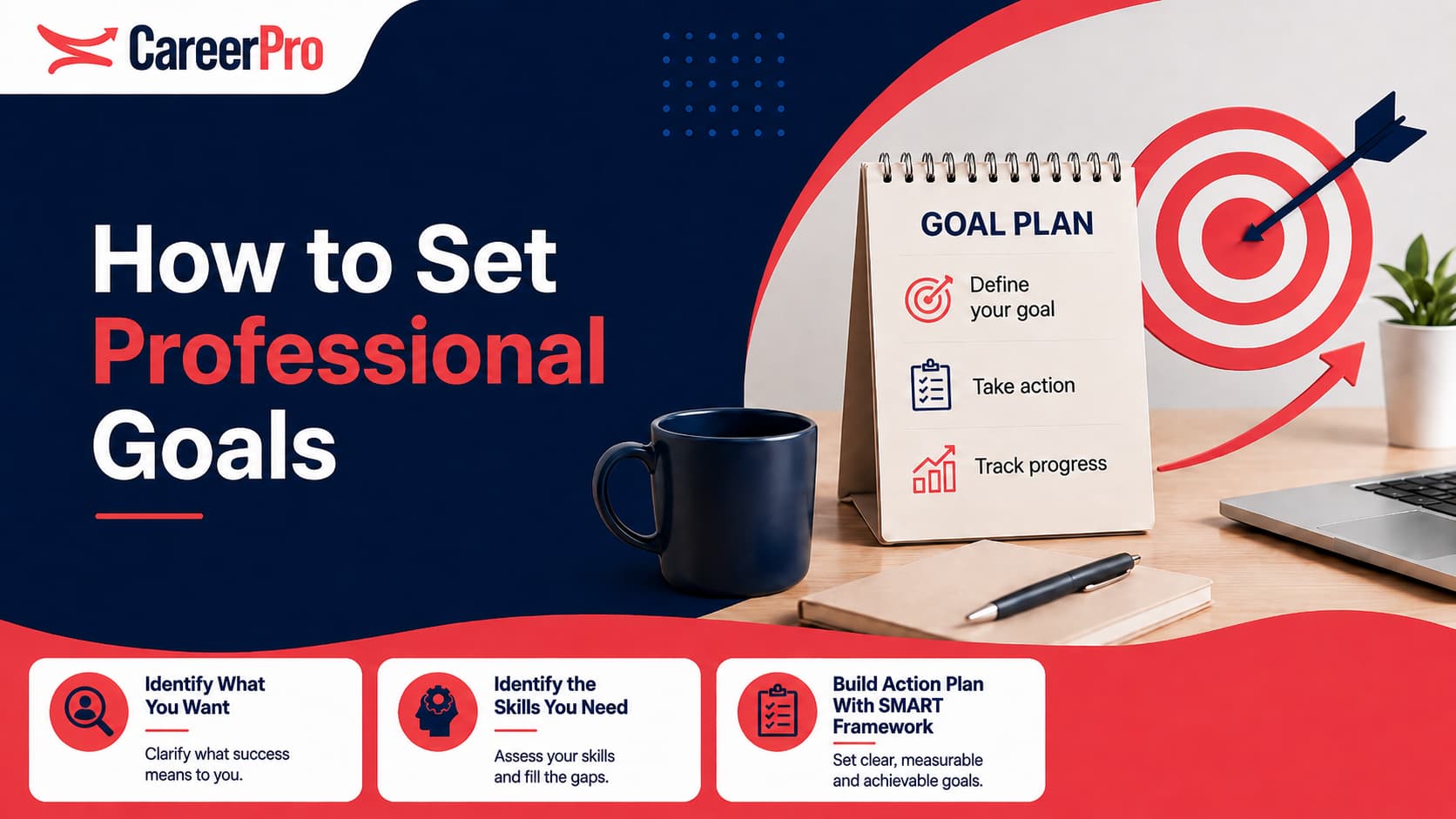
1) Identify what you want to achieve, 2) Identify the skills you need, 3) Build an action plan using the SMART framework, 4) Prioritize opportunities that support your goals, 5) Stay consistent when progress feels slow, 6) Review and adjust your plan regularly.
1) Identify What You Really Want to Achieve
Identify what you want to achieve. Reflect on what success means to you today — ask what motivates you, where you want your career in 5 years, and what role would fulfill you professionally. Your priorities may have changed as you gained experience, learned new skills, or discovered what you value in a workplace.
Here are some questions that you must ask yourself to set a direction for where you want to go:
- What motivates me to do my best work?
- Where do I want my career to be in the next five years?
- What type of role would make me feel professionally fulfilled?
- Which three qualities or benefits matter most to me in a job?
- What kind of work do I want to be known for?
Example
A graphic designer who enjoys organizing team files and streamlining workflows may realize that their real career goal is design operations rather than becoming a lead designer.
2) Identify the Skills You Need to Move Forward
Identify the skills you need. Compare your current skills against what your target role requires, then close the gap through courses, certifications, mentorship, or hands-on projects. Be honest with yourself about where you stand right now and which improvements you need to achieve professional goals.
Let’s make a quick assessment of:
- What do you already do well?
- Which areas need improvement?
- What does your desired position require that you currently lack?
- Could a course, certification, mentor, or practical project help?
Example
If you want to move from a junior marketing role to a senior position, you may need stronger data analysis, campaign management, communication, or leadership skills.
3) Build Action Plan With SMART Framework
Once you understand what you want, start creating an action plan by breaking your long-term goals into more immediately attainable short-term goals by using the SMART technique.
SMART is an acronym for Specific, Measurable, Achievable, Relevant, and Time-Bound — a framework for turning long-term career goals into short-term action steps: Specific (define exactly what you want), Measurable (track progress), Achievable (keep it realistic), Relevant (align with your career direction), Time-Bound (set a deadline).
Example
If your long-term goal is to become an SEO leader in 2 years, with the SMART technique you can plan like this: Within the next 3 months, I will lead one small SEO project and ask my manager for feedback to improve my leadership skills.
4) Prioritize Opportunities That Support Your Goals
Prioritize opportunities that support your goals. Before applying, confirm the role builds relevant skills, offers real growth, and moves you closer to your target career — not just a bigger paycheck or title
Before applying, consider:
- Does this role help me develop relevant skills?
- Will I gain valuable experience?
- Does the company offer opportunities for career growth?
- Does the position match my interests and strengths?
- Will this move take me closer to the career I actually want?
Example
If your goal is to work in senior HR, an HR coordinator role offering recruitment and employee-management experience may be a better choice than a higher-paying administrative position.
5) Stay Consistent When Progress Feels Slow
Professional growth rarely happens overnight. There may be periods when you feel like you are working hard without seeing immediate results. This is where consistency matters. Instead of focusing only on the final destination, pay attention to the progress you are making along the way.
Stay consistent when progress feels slow. Maintain momentum by completing courses, improving one skill at a time, taking on new responsibilities, asking for feedback, and tracking your achievements — rather than focusing only on the end goal.
Example
If you want to move to a senior architect role, then take responsibility for larger projects and improve technical and project-management skills to experience the progress.
6) Review and Adjust Your Career Plan
Review and adjust your career plan every few months. Ask what you’ve achieved, what’s holding you back, which goals still matter, and whether your timeline needs to change
Example
A marketing manager wants to become a director within two years. She gets the chance to lead a major product launch, so she adjusts her timeline while keeping her goal the same.
Conclusion
Having professional goals gives you something more valuable than a checklist. By understanding how to set professional goals, you get a sense of direction in your career by knowing what you are working toward.
If you’re ready to take the next step in your career, Career Pro can help you connect with relevant job opportunities and find roles that align with your skills and career goals. Explore Career Pro today and take the next step toward your professional future.